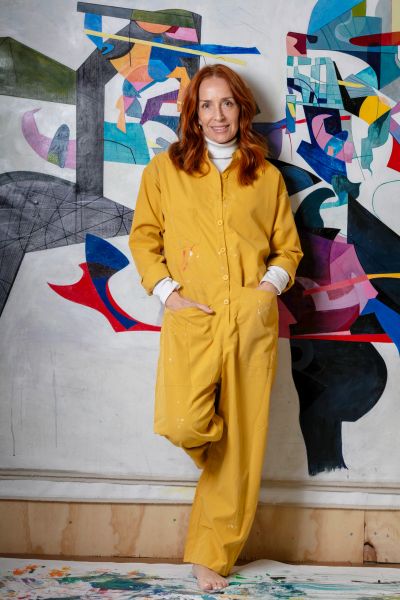
NI DE AQUI NI DE ALLA (In Betweenness)
The phrase sounds like a condemnation. “Neither Here nor There” evokes a dark place that belongs to no one because no one has wished to claim it; a space without doors, paths, or any way out. Something like the “No Man’s Land” of the First World War: that devastated, barren strip between two opposing trenches, where nothing grows and where, by this logic,
remaining too long means becoming trapped forever in a void.
But Isabel Brinck proposes precisely the opposite.
The space she inhabits, that state of “in-betweenness” which is neither here nor there,is not an empty wasteland, but a vibrant space, with form, time, and direction. It is filled with
memories and experiences gathered on both sides of the journey. And those two sides, far from opposing one another, are complementary. Here and there are not trenches fighting over a territory, but two roots nourishing the same person: family histories, friendships that
endured the distance, and years of growth shaped by pain and loss, but also by all that was gained, learned, and transformed into maturity.
I had the privilege of witnessing that passage up close.
Exactly twenty-four years ago, we began an artistic journey together. For her, it flourished; for me, it took other directions. But I was there at the beginning, when those organic, fluid forms were already appearing in her work,forms that would acquire new layers over time. I was close to her when she left Chile to live in Miami. Since then, I have followed her evolution as both an artist and a person, watching her move from one place to another and, almost without fully
intending to, build along the way this territory of her own: that space in between, belonging neither entirely here nor entirely there.
Isabel gathers the most meaningful elements from the places and periods she has
inhabited, not out of nostalgia, nor in an attempt to preserve or reconstruct what was left behind, but to give shape to something different. I think of houses built with materials
reclaimed from older structures. From what once belonged to another building, the finest beams are rescued, along with a singular door or a window marked by time. These elements retain traces of what they once were, but they no longer belong to the original structure;
nstead, they become part of something new. Something similar occurs in her painting: the past ceases to belong entirely to a single place, and “here and there” become intertwined, taking on a new configuration.
Isabel is in Chile now, but she has not returned to the same place she once left, nor is she the same person. She returns from a territory of her own to reveal that territory to us, a place built over many years from experiences, losses, discoveries, and affections. And just as I shared in her beginnings and witnessed her departure, today I am honored to accompany her return. She invites us to look at the fragments from which each of us has constructed our own life and to ask ourselves what we have preserved, what we have left behind, and what new space we might build from all that still remains with us.
Pilar Ducci
narrator, editor and cultural communicator
La expresión suena a condena. "Ni de aquí ni de allá" evoca un lugar oscuro que no
pertenece a nadie porque nadie ha querido reclamarlo. Un espacio sin puertas, sin caminos y sin salida. Algo así como la "Tierra de Nadie" de la Primera Guerra Mundial: esa franja
arrasada y estéril entre dos trincheras enfrentadas, donde no crece nada y donde, en esta lógica, permanecer demasiado tiempo significa quedar atrapado para siempre en un vacío.
Pero Isabel Brinck nos propone exactamente lo contrario.
El espacio que habita, ese “in betweenness” que no es “ni de aquí ni de allá”, no es un
espacio descampado, sino un espacio vibrante, con forma, con tiempo y con dirección. Está lleno de recuerdos y experiencias recogidos a ambos lados del viaje. Y esos lados, lejos de
enfrentarse, se complementan. Aquí y allá no son trincheras que disputan un territorio, sino dos raíces que alimentan a una misma persona: historias de familia, amistades que resistieron la distancia, años de crecimiento hechos de dolores y pérdidas, pero también de mucho ganado, mucho aprendido y mucho madurado.
Tuve el privilegio de ver ese tránsito de cerca.
Hace exactamente veinticuatro años comenzamos juntas un camino artístico. En ella prosperó; en mí tomó otras direcciones, pero estuve al comienzo, cuando en su obra ya aparecían esas formas orgánicas y fluidas que con el tiempo adquirirían nuevas capas. Estuve cerca cuando dejó Chile y se fue a vivir a Miami. Y desde entonces he seguido su evolución como artista y como persona, viéndola ir de un lado al otro y, sin proponérselo del todo, levantar en el trayecto este espacio propio, ese entremedio que no es ni de aquí ni de allá.
Isabel recoge lo más significativo de los lugares y tiempos que ha habitado, sin nostalgia, sin tratar de preservar o reconstruir lo que quedó atrás, sino para dar forma a algo distinto. Pienso en esas casas construidas con materiales recuperados de antiguas edificaciones. De lo que alguna vez fue otra construcción se rescatan las vigas más nobles, una puerta singular, una ventana marcada por el tiempo. Los elementos conservan la huella de lo que fueron, pero dejan de pertenecer al edificio original para integrarse a uno nuevo. Algo semejante ocurre en su pintura: el pasado deja de pertenecer por completo a un solo lugar, y el “aqui y alla” se
entrelazan, adquiriendo una nueva configuración.
Isabel está en Chile ahora; pero no ha vuelto al mismo lugar del que partió, y ella tampoco es la misma. Vuelve desde un territorio propio para mostrarnos ese territorio, construido durante años con experiencias, pérdidas, descubrimientos y afectos. Y si compartí sus inicios y fui
testigo de su partida, hoy me honra acompañar su retorno, porque ella nos invita a mirar los
fragmentos con los que cada uno ha construido su propia vida y a preguntarnos qué
conservamos, qué dejamos atrás y qué espacio nuevo podemos levantar con aquello que
todavía nos acompaña.
Pilar Ducci
narradora, editora y comunicadora cultural.
NI DE AQUÍ NI DE ALLÁ (In Betweenness)
NI DE AQUÍ NI DE ALLÁ (In Betweenness)
An exhibition that reflects on the search for home—not as a physical place, but as a state of being.
Opening Reception
September 3, 2026 · 7:00 PM
Zoco Santiago
Santiago, Chile